
Harvesting of Kashmiri Mamra Almonds: From Orchard to Your Table

Every kernel of Kashmiri Mamra almond you eat has a story. It begins in a family orchard tucked somewhere in the almond belt of South Kashmir in districts like Pulwama, Shopian, and Budgam, where almond trees have stood for generations, tended by the same families that planted them decades ago. No machines. No chemical sprays. No industrial shortcuts. Just hands, knowledge passed down through generations, and an unhurried process that the modern food industry has largely forgotten. This is how Kashmiri Mamra almonds are grown, harvested, and brought to your table.
Where Kashmiri Mamra Almonds Grow
The almond belt of Kashmir stretches across the fertile valleys of South Kashmir, with Pulwama at its heart, approximately 45 kilometres from Srinagar. The region sits at high altitude, where the combination of cool Himalayan temperatures, mineral-rich soil fed by glacial streams, and clean mountain air creates growing conditions that cannot be replicated elsewhere. Mamra almonds are scientifically classified as Prunus dulcis. They thrive in sandy, loamy, or clayey soil with a pH level around 7.5. The high altitude is not just a geographic detail it directly influences the density of nutrients in every kernel. The longer, cooler growing season means the almond develops more slowly, concentrating its natural oils, antioxidants, and healthy fats more richly than almonds grown at lower altitudes.
Mamra almonds account for less than 5 per cent of global almond production. This rarity is not by design; it is simply a result of the specific growing conditions required and the labour-intensive process involved. There is no way to mass-produce a Kashmiri Mamra almond. The land and the method do not allow for it.

The Growing Cycle: Season by Season
Understanding the harvest begins with understanding the full year of work that precedes it.
Winter: Rest and Preparation
Through the cold Kashmiri winter, the almond trees lie dormant. Farmers use this period to tend the soil, prune branches, and prepare the orchards for the coming season. The frost-hardened earth slowly thaws as winter gives way to early spring.
Spring: Blossoming
This is the most visually striking moment in the almond calendar. As temperatures rise in February and March, the almond trees burst into bloom, covering the orchards in delicate white and pink blossoms that stretch across the valley like a natural canvas. It is one of the most beautiful sights in Kashmir, and it marks the beginning of the growth cycle. The blossoms attract pollinators, primarily bees that are essential for fertilisation. Without them, there are no almonds. Kashmiri farmers have long understood this relationship, and the organic, chemical-free farming practices that define Mamra cultivation are partly responsible for this pollination being so effective. Pesticides and chemical sprays would destroy the very ecosystem that makes the crop possible.

Late Spring and Early Summer: Development
By May, small almonds begin to form. The outer green hull, the soft, fleshy layer that surrounds the shell, protects the developing kernel through the summer months. Farmers monitor the trees carefully during this period, watching for signs of stress, disease, or pest activity and managing them through natural, traditional methods.
Late Summer: Harvesting Season
By mid to late summer, the almonds reach full maturity. The outer green hull begins to crack and dry, a natural signal that the almond inside is ready. This is when the harvest begins, and it is entirely done by hand.
The Harvest: A Labour of Tradition
The harvesting of Kashmiri Mamra almonds is one of the most labour-intensive agricultural processes in the region. Entire families participate, men, women, and children, in a seasonal ritual that has changed little over centuries.
The Threshing: Long wooden poles traditionally made from Himalayan cedar are used to thresh the branches of the almond tree. The ripe almonds fall to the ground, where they are collected by hand. This method requires skill and experience. Too forceful, and unripe almonds fall with the ripe ones. Too gentle, and the ripe almonds stay on the tree past their peak.

Handpicking for Ripeness: Not all almonds on a single tree ripen at the same time. Experienced farmers handpick, selectively taking only the almonds whose hulls have cracked open naturally, leaving the rest to ripen further. This selective harvesting ensures that only the best, most nutritionally dense almonds make it to the next stage. This is precisely what makes Kashmiri Mamra almonds different from commercially farmed varieties. California almonds, for example, are harvested by machines that shake entire trees in a single pass, taking ripe and unripe almonds together, with no selectivity. The difference in quality is the direct result of this difference in method.
Collection and Initial Sorting: Once fallen, the almonds are gathered from the ground and collected in large cloth sheets spread beneath the trees. Any damaged, discoloured, or undersized almonds are set aside at this stage. The selected almonds move forward to the hulling process.

Post-Harvest: From Shell to Kernel
The journey from freshly harvested almond to the premium Mamra kernel in your hand involves several careful steps, all done by hand.
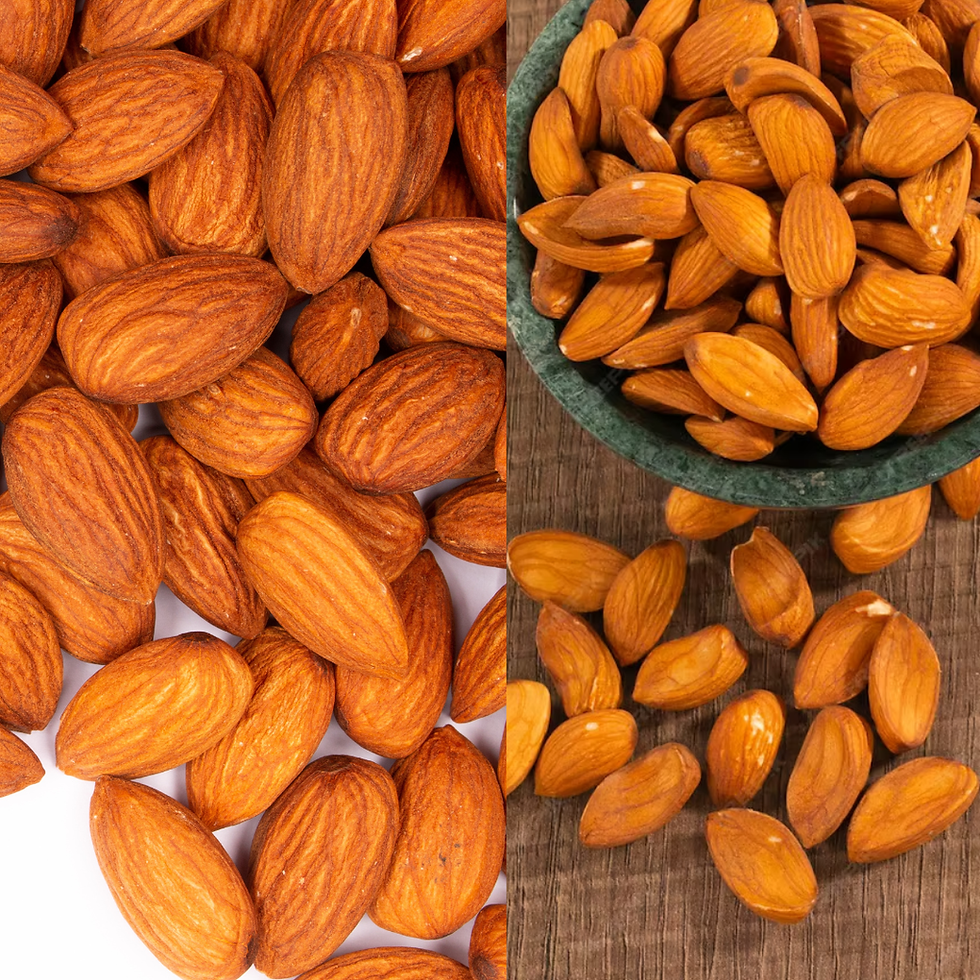
Hulling: The outer green hull and the hard shell are removed to reveal the almond kernel inside. This is done manually using traditional tools, preserving the natural texture and oils of the kernel. Mechanical hulling used in commercial almond production applies pressure and friction that can damage the delicate outer layer of the kernel and reduce its natural oil content.

Natural Sun-Drying: Once hulled, the almond kernels are spread out under the Kashmiri sun for natural drying. This is one of the most important steps in the entire process. Sunlight naturally reduces moisture content, enhances the almond's flavour, and preserves the natural oil without the application of heat. Commercial almonds are typically dried using industrial heat dryers, a faster process, but one that reduces nutritional value and affects the natural oils that make Mamra almonds what they are. The Kashmiri sun-drying process takes longer but produces a kernel that is richer, more aromatic, and more nutritionally intact.
Hand-Sorting: After drying, every almond is hand-sorted one more time. Damaged, shrivelled, or discoloured kernels are removed. Only the best kernels uniform in size, colour, and texture make it to the packaging stage. This level of quality control is simply not possible in machine-sorted, mass-produced operations.
Why This Process Matters
The way a food is grown and harvested directly determines its quality. This is not marketing language; it is an agricultural fact. Kashmiri Mamra almonds have nearly double the natural oil content of commercially farmed almonds because they are grown at high altitude, harvested at peak ripeness, and sun-dried rather than heat-dried. Each of these factors contributes to the final nutritional profile. The chemical-free cultivation means no pesticide residue. The handpicking means no unripe almonds in the batch. The sun-drying means the natural oils are intact. You are eating the direct result of a process that has prioritised quality at every single step, not efficiency, not yield, not shelf life.
Supporting the Farmers Behind Every Kernel
The families who grow Kashmiri Mamra almonds are not large-scale agribusinesses. They are small, family-owned orchards in the valleys of Pulwama, Shopian, and Budgam, many with just a few hundred trees, some with more. The almond harvest is one of the most important economic events in their year. At Kashmir Allure, we source directly from these farmers. No middlemen, no brokers. The price you pay goes directly to the families who spent the entire year tending the orchards, harvesting by hand, and ensuring every kernel meets the standard that Kashmiri Mamra almonds have always stood for.
From Kashmir's Orchards to Your Home At Kashmir Allure, our Mamra almonds are:
Sourced directly from family orchards in South Kashmir's almond belt
Handpicked at peak ripeness
Naturally sun-dried without artificial heat
Hand-sorted for quality before packing
Cold-stored to preserve freshness and natural oil content
Free from chemical treatment, polishing, or artificial processing
FSSAI certified


Comments